Show summary Hide summary
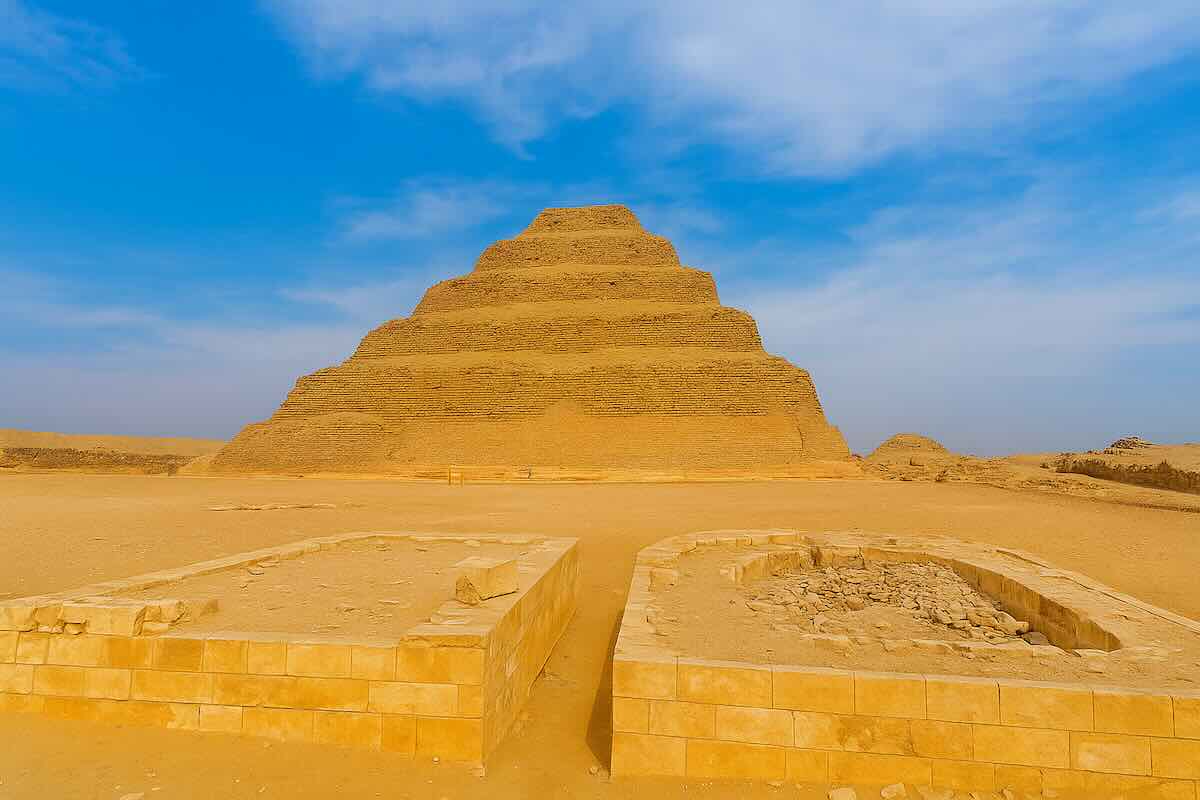
Imagine giant limestone blocks gliding upward as if guided by an unseen force. How did ancient Egyptians lift over 11 million stones to build the Step Pyramid of Djoser with limited manpower? A recent French-led study unveils that an ingenious hydraulic elevator system may have been the secret to their success.
A revolutionary hydraulic elevator system
French archaeologists under Xavier Landreau at the Commissariat à l’Énergie Atomique et aux Énergies Alternatives combined satellite imagery with on-site digs to uncover a network of water-filled shafts inside the pyramid. This innovative machinery used controlled floods to raise heavy blocks, reducing the need for brute human force.
Adjacent to Djoser’s Step Pyramid lies the “Gisr el-Mudir enclosure,” which functioned as a dam during the Nile’s annual floods. By channeling silt-free water into purpose-built wells, ancient builders could harness hydraulic energy to lift stones in a series of gentle, water-driven steps.
The power of hydraulic energy in pyramid construction
Unlike traditional ramp theories, this model suggests water pressure did the heavy lifting. As each well filled, the rising water level carried blocks upward on platforms—an early form of elevator. Once stones reached the next level, workers would drain the water and move the blocks into place.
This approach turned raw hydraulic energy into a precise lifting mechanism, cutting manpower requirements and accelerating construction. It reframes our understanding of how a society without modern tools achieved such epic scale.
Insights into ancient Egyptian engineering
We often picture long lines of laborers hauling sledges, but the discovery of water-powered lifts highlights the Egyptians’ technical ingenuity. Far from relying solely on muscle, they orchestrated a unified system to control and regulate floodwaters for construction.
I recall visiting Saqqara at dawn, awed by the pyramid’s shadow stretching across the desert. That moment taught me that beneath every monumental ruin lies a story of human creativity and problem-solving—true hallmarks of ancient Egyptian engineering.
Implications for future archaeological research
While ramps and levers were almost certainly in play, confirming hydraulic methods reshapes excavation priorities at other sites. Researchers now plan to probe neighboring pyramids for similar waterworks, hoping to prove this technique wasn’t unique to Djoser’s tomb.
If corroborated elsewhere, the role of innovative machinery in Old Kingdom construction will demand a major rewrite of textbooks. It’s an invitation to rethink how we teach and appreciate the breadth of ancient technological advances.
What do you think of this breakthrough? Have you ever considered the role of water in lifting those colossal stones? Share your thoughts below, leave a comment, and pass this article on to spark more conversations about the marvels of ancient Egyptian engineering!